
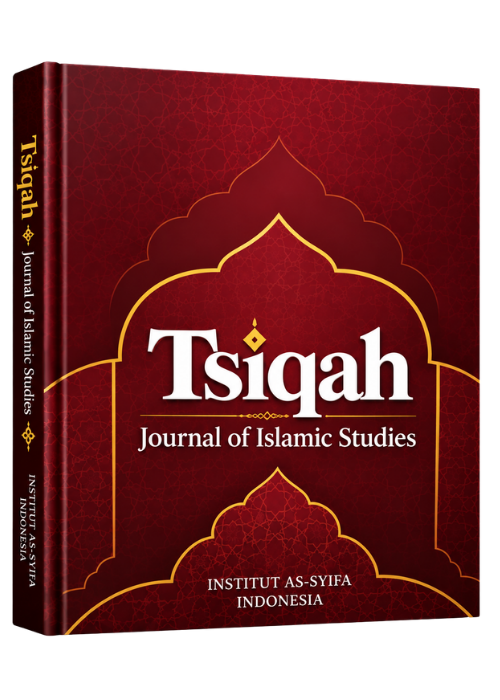
 Tsiqah: Journal of Islamic Studies is a scientific journal published by Center for Research and Community Service (P3M) As-Syifa Institute Subang, Indonesia. The journal is published biannually (Desember and Juni) and was published for the first time in Desember 2026. This is a peer-reviewed journal in the field of Islamic Studies and Contemporary Muslim Civilization and is intended to communicate original research and current issues on the subject. Articles that have been submitted will be subject to an initial review by the editorial board for a decision to continue with the reviewers or be returned to the authors. The writing is emphasized to have theoretical, empirical, methodological originality, scientific impact and a good level of readability. The editorial board will immediately make a decision on the articles you submit, no later than 4 weeks after being submitted. Our work is also licensed under
Authors
In choosing to use Generative AI tools, authors of the journal are expected to do so responsibly and in accordance with the journal's policies on publishing ethics.
Authors must clearly acknowledge within the article any use of Generative AI tools through a statement that includes: the full name of the tool used (with version number), how it was used, and the reason for its use.
For article submissions, this statement must be included in the Methods or Acknowledgments section.
This level of transparency ensures that editors can assess whether Generative AI tools have been used responsibly. Tsiqah Journal will retain its discretion over the publication of the work, ensuring that integrity and guidelines have been upheld.
Editors
Editors are responsible for ensuring the quality and integrity of research content. Therefore, editors must keep submission and peer review details confidential.
The use of manuscripts in Generative AI systems may raise risks around confidentiality, infringement of proprietary rights, and other concerns. Consequently, editors must not upload unpublished manuscripts, including any associated files, images, or information, into Generative AI tools.
Editors should consult with the Editor-in-Chief prior to using any Generative AI tools, unless they have already been informed that the tool and its proposed use are authorized.
Peer Reviewers
Peer reviewers are selected experts in their fields and should not use Generative AI for analysis or to summarize submitted articles or portions thereof in the creation of their reviews. Peer reviewers must not upload unpublished manuscripts or project proposals, including any associated files, images, or information, into Generative AI tools.
Generative AI may only be utilized to assist with improving review language, but peer reviewers remain fully responsible for ensuring the accuracy and integrity of their reviews.